
Affiliate disclosure: As an Amazon Associate I earn from qualifying purchases. I may earn a commission, at no extra cost to you, when you buy through affiliate links.
A cordless leaf blower for wet autumn leaves needs controllable airflow, a manageable working weight and enough battery time at the setting you will actually use. A battery-and-charger kit is the sensible starting point if you do not already own a compatible system. However, no voltage label or maximum air-speed figure guarantees that a blower will lift a compacted, sodden mat.
This researched shortlist compares three manufacturer-listed UK kits. We have checked the published specifications and instructions, not carried out a hands-on performance test. All three blow leaves into piles; they do not vacuum or shred them. If collecting into a bag is essential, start with our leaf blower versus leaf vacuum guide.
Table of Contents
Which kit fits your job?
- Small paths and frequent light tidy-ups: Bosch UniversalLeafBlower 18V-130. Its low published working weight makes it the first option to consider where handling matters more than moving a large leaf fall. It is not our first choice for a thick wet layer.
- Repeated clearing and a route into Makita LXT: Makita DUB184RT. The supplied 5.0 Ah battery, variable speed and lock-on control make this a useful kit to investigate for regular work. Do not assume its larger Ah number means longer runtime than another brand’s kit.
- Heavier patches with short bursts of extra airflow: EGO LB5301E. Its boost mode has a clearly stated runtime trade-off. It is the shortlist option we would investigate first for stubborn damp leaves, provided you can manage its fitted weight and collect the loosened piles.
These are recommendations by likely job and published features, not a tested finishing order. For a tiny courtyard, a broom may still finish the job with less equipment and noise.
Compare the exact kit, not the bare tool
| UK kit | Battery and charger included | Published weight and what it means | Air-performance information |
|---|---|---|---|
| Bosch UniversalLeafBlower 18V-130, 06008A0670 | One PBA 18V 2.5 Ah battery and AL 18V-20 charger | 1.6 kg with the 2.5 Ah battery, as specified in the manual | Maximum 130 m³/h airflow; two speeds; published air speed 185–245 km/h |
| Makita DUB184RT | One BL1850B 18V 5.0 Ah battery and rapid charger | Manufacturer gives 2.5–3.0 kg with battery across configurations, not a separate measured weight for this kit | Up to 13 m³/min airflow, equivalent to 780 m³/h; variable speed and lock-on |
| EGO LB5301E | One 2.5 Ah EGO battery and standard charger; AN5300 flat nozzle also listed | 2.2 kg without the battery; the ready-to-use tool is heavier | Up to 900 m³/h in boost; variable speed; published maximum blowing force 16 N |
Check the seller’s complete contents against the kit code before paying. Bosch 06008A0601 and Makita DUB184Z are bare-tool versions; EGO LB5300E is the blower rather than the LB5301E kit. Confirm the rapid-charger model on the Makita offer, and distinguish the manufacturer kit from any seller-created bundle. Ask to handle each blower with the intended battery fitted.
Compare UK listings: these affiliate links open Amazon UK searches, not a verified in-stock offer. Match the full kit code and confirm the supplied battery, charger, seller and current price.
- Search for the Bosch 06008A0670 kit
- Search for the Makita DUB184RT kit
- Search for the EGO LB5301E kit
Read runtime at the setting you need
| Kit | Published runtime evidence | Buying implication |
|---|---|---|
| Bosch 06008A0670 | Up to 18 minutes on the product page; the displayed claim does not identify the speed setting | Treat it as a qualified maximum, not a promise of 18 minutes moving wet leaves at full output |
| Makita DUB184RT | The UK specification’s 12-minute continuous-use figure is for a 6.0 Ah battery, not the supplied 5.0 Ah pack | A directly applicable 5.0 Ah runtime is not established by that figure; do not transfer it to this kit |
| EGO LB5301E | The linked LB5300E manual gives approximately 75 minutes low, 23 minutes high and 10 minutes boost with a 2.5 Ah battery | Plan demanding work around the high/boost figures, with allowances for conditions, rather than the 75-minute headline |
These manufacturer figures were not obtained in one shared test. Leaf condition, output setting, battery condition and temperature can change working time. A spare compatible pack may help, but adds cost and storage requirements. If your regular clearing job outlasts a practical battery session and a safe mains connection is available, compare our corded leaf blowers and vacuums.
Bosch: start here for manageable light clearing
The Bosch is a useful starting point for someone who wants to clear scattered leaves from paths between larger autumn tidy-ups. Its two-position speed control is straightforward, and the manual’s 1.6 kg figure includes the kit’s 2.5 Ah battery. That is more informative for handling than a headline bare-tool weight.
The limitation is the job you expect it to do. A narrow nozzle can produce a high air-speed number without moving the same volume of air as a larger blower. Buy it for convenient small-area work, not because 245 km/h sounds like proof of superior wet-leaf performance. Existing battery owners should verify the exact Bosch 18V POWER FOR ALL compatibility rather than assuming every Bosch battery fits.
Makita: consider it for regular clearing and LXT ownership
The DUB184RT supplies a 5.0 Ah LXT pack with a brushless blower, variable speed and a lock-on feature. It is worth considering when you expect repeated clearing sessions and also have a reason to use the battery on compatible LXT tools. If you already own suitable packs and a charger, compare the cost and contents of the body-only option before buying another kit.
The published airflow is substantial, but it is not a verified wet-leaf clearance rate. The important unanswered buying question is how long the supplied pack lasts at your chosen setting. Request a relevant demonstration or manufacturer clarification if that determines whether one battery will cover your garden. Check the fitted balance and weight as well as the specification range.
EGO: a clearer boost trade-off for heavier patches
EGO explicitly positions the LB5301E’s boost function for stubborn wet leaves and heavier patches. That makes it a relevant candidate for autumn use, while the manual’s roughly ten-minute boost runtime makes the compromise visible. Use extra power where it helps, then reduce it for loose material rather than treating boost as the default for an entire session.
Do not confuse the quoted 2.2 kg body weight with the weight in your hand. A battery is still required, and a larger compatible pack changes the balance as well as the working time. The included flat nozzle changes the air stream; compare demonstrations using the attachment you expect to use. Manufacturer suitability claims do not guarantee that every saturated pile will move cleanly.
Why air speed, airflow and voltage need separate checks
Air speed describes how fast air leaves the nozzle; airflow describes the volume moved. The Makita conversion above simply multiplies m³/min by 60 to express m³/h. It does not make the manufacturers’ test methods or nozzle arrangements identical. Blowing force, where published, is another useful figure, but none of these alone tells you how much of your lawn will be cleared per charge.
Battery Ah figures should also be compared within the same voltage and compatible platform. Neither a higher voltage nor an axial-fan label proves that one complete machine is better for damp leaves. Controls, nozzle reach, the battery fitted and the surface being cleared all matter.
Clear wet leaves without making the job harder
- Inspect first. Remove wire, stones and other dangerous loose objects. Keep people, pets, windows and vehicles out of the debris path. Follow the manual’s bystander distances and protective-equipment instructions.
- Loosen compacted material. A rake or broom may separate a wet mat more effectively than holding a blower on maximum. Wait for a drier spell where practical, and work in smaller sections.
- Choose the right surface method. On gravel, prefer careful hand collection or a suitable rake where stones could be thrown. A low blower setting does not make loose stones harmless. See our leaf-collecting tools for lawns, gravel and borders.
- Plan the collection. Work with the wind and gather manageable piles. Blowing leaves does not remove them from the garden: lift suitable material into a bag or use it to make leaf mould.
Wet leaves are not permission to use a machine in rain. Follow the exact manual’s weather restrictions; keep batteries and charging equipment dry. Stop, remove the battery and wait for moving parts to stop before changing attachments, clearing debris or cleaning. Never reach into an intake while the tool can operate.
Do not clear every leaf from every border. Check for animals before disturbing piles and leave suitable habitat where it is useful. Our guide to what to clear and leave in autumn helps separate paths and lawns that need attention from areas that can remain undisturbed.
Sources and how this comparison was prepared
Kit contents and specifications were checked on 24 October 2026 using the manufacturer links in the comparison table. Supporting instructions include the Bosch UniversalLeafBlower manual and the EGO LB5300E manual linked from the kit page. Specifications and bundle contents can change; check the supplied instructions and exact offer before purchase. No price, stock guarantee or independent test score is claimed.
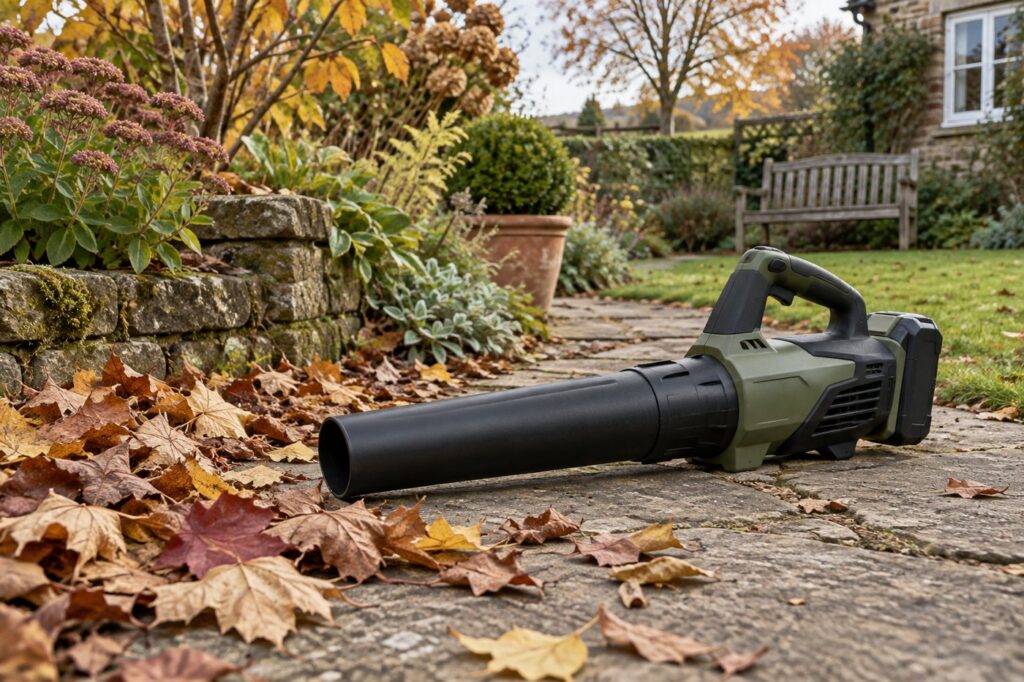
The feature image is an AI-generated illustration. Product recommendations are based on published information and the stated job, not hands-on testing.