
Table of Contents
Introduction: The UK Lawn Care Landscape in 2026
The British obsession with a well-maintained lawn continues in 2026. We’re seeing a growing market for both petrol and electric lawn mowers, driven by increasingly busy lifestyles and a heightened awareness of environmental responsibility. Garden sizes remain varied across the UK, impacting mower choice significantly. Increasingly sophisticated battery technology – offering longer runtimes and faster charging – is making electric mowers a more viable option than ever before, even for larger gardens. This article will provide a comprehensive comparison to help you choose the right mower for your needs.
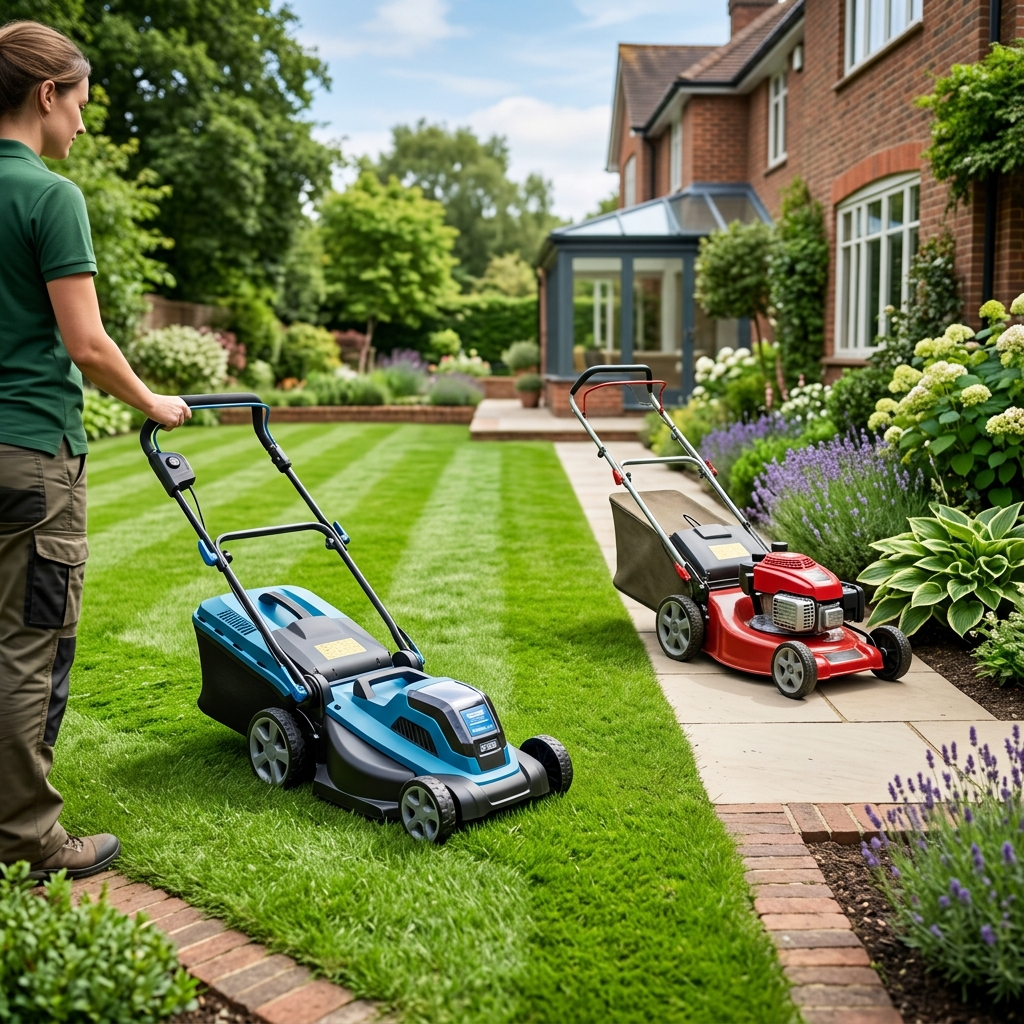
Petrol Lawn Mowers: The Traditional Powerhouse
Petrol lawn mowers have long been the workhorse of British gardens, favoured for their power and reliability. Engine sizes typically range from around 100cc for smaller gardens to 190cc or more for larger areas. Cutting widths vary from 40cm to 70cm or even wider. You’ll find both push mowers and self-propelled models; self-propelled options are particularly useful on slopes or for those who prefer less physical exertion. Fuel options primarily remain unleaded petrol, though a growing proportion of petrol stations now offer E10 fuel (containing up to 10% ethanol). Models like the Mountfield SP555 Petrol Lawn Mower (£399) and Stihl RM 2 RT Petrol Lawn Mower (£479) are popular choices.
Pros:
- Power: Excellent for tackling thick grass and uneven terrain.
- Runtime: Unlimited runtime – simply refuel when needed.
- Suitability: Ideal for large gardens (over 500 square metres).
- Robustness: Generally more durable and long-lasting (with proper maintenance).
Cons:
- Environmental Impact: Produces emissions and contributes to air pollution.
- Noise: Significantly louder than electric mowers.
- Maintenance: Requires regular maintenance (oil changes, spark plugs, etc.).
- Starting: Can sometimes be difficult to start, especially in cold weather.
Electric Lawn Mowers: Quiet, Clean, and Convenient
Electric lawn mowers are gaining traction, offering a quieter and more environmentally friendly alternative to petrol models. They fall into two main categories: corded and cordless (battery-powered). Corded mowers are cheaper but restrict your movement. Cordless mowers, powered by lithium-ion batteries, offer greater freedom. Battery voltage is a key indicator of power, ranging from 20V to 48V or higher. Runtime depends on the battery capacity (measured in Amp-hours – Ah) and the thickness of the grass. Charging times vary from 1 to 4 hours. Consider the Flymo EasiGlide 300R Electric Lawn Mower (£179) for smaller gardens, or the more powerful Bosch Cordless 36V Grass 48 (£449) and Greenworks 40V Cordless Lawn Mower (£299) for medium-sized lawns.
Pros:
- Environmentally Friendly: Zero emissions during operation.
- Quiet Operation: Significantly quieter than petrol mowers.
- Low Maintenance: Fewer maintenance requirements than petrol mowers.
- Ease of Use: Lightweight and easy to manoeuvre, often with simple start mechanisms.
Cons:
- Runtime (Cordless): Limited runtime depending on battery capacity.
- Power (Cordless): May struggle with very thick or wet grass (lower voltage models).
- Cord Restriction (Corded): Limited by the length of the power cord.
- Battery Replacement Cost: Batteries degrade over time and eventually need replacing.
Head-to-Head Comparison: Petrol vs Electric – Key Features
| Feature | Petrol Lawn Mower (2026) | Electric Lawn Mower (Corded) (2026) | Electric Lawn Mower (Cordless) (2026) |
|---|---|---|---|
| Power | High | Medium | Medium to High (depending on voltage) |
| Running Costs | £80-£150/year | £10-£20/year | £20-£40/year |
| Maintenance | High (oil, spark plugs, filters) | Low (blade sharpening) | Medium (blade sharpening, battery care) |
| Noise Levels | 85-95 dB | 70-80 dB | 70-85 dB |
| Weight | 25-45 kg | 10-15 kg | 15-25 kg (including battery) |
| Environmental Impact | High (emissions) | Low (zero emissions during use) | Low (zero emissions during use) |
| Suitability for Garden Size | Large (500m²+) | Small to Medium (up to 300m²) | Medium to Large (up to 500m², depending on battery) |
| Initial Cost (2026) | £350 – £700+ | £100 – £250 | £250 – £500+ |
Running Costs: A Detailed Breakdown (2026 Prices)
Let’s consider a typical UK garden of 400 square metres. Projected petrol prices in 2026 are around £1.60 per litre, and unleaded consumption for a typical mow is approximately 0.5 litres. Electricity prices are projected at £0.30 per kWh. Assuming 10 mows per season:
- Petrol: 10 mows x 0.5 litres/mow x £1.60/litre = £8.00 fuel cost. Add £30-£50 for annual oil change = £38-£58/year.
- Corded Electric: Assuming 1 kWh consumption per mow x 10 mows x £0.30/kWh = £3.00/year
- Cordless Electric: Assuming 1.5 kWh consumption per mow x 10 mows x £0.30/kWh = £4.50/year. Factor in potential battery replacement every 3-5 years (£100-£200). Average annual battery cost = £20-£40. Total: £40-£60/year.
Maintenance: What’s Involved?
Petrol Mowers: Require regular oil changes (approx. £30-£50 per year), spark plug replacement (approx. £15-£30 every 2 years), air filter cleaning/replacement (approx. £10-£20 per year), and occasional carburetor cleaning (approx. £40-£80 as needed). Total estimated annual maintenance cost: £80-£150.
Electric Mowers: Primarily require blade sharpening (£15-£30 every 1-2 years). Cordless models also need battery care – avoid deep discharge and store correctly. Total estimated annual maintenance cost: £10-£20 (corded) or £20-£40 (cordless including potential battery care/monitoring).
Environmental Impact: Which is Greener?
Petrol mowers undoubtedly have a greater environmental impact due to combustion emissions. Electric mowers produce zero emissions during operation, but the electricity source needs to be considered. If your electricity comes from renewable sources, the environmental benefit is significantly higher. Battery disposal is also a concern, but recycling programs are becoming more widespread. Advancements in battery technology – including increased energy density and the use of more sustainable materials – are further reducing the environmental footprint of electric mowers.
Choosing the Right Mower for Your Garden
- Small Garden (under 200m²): Corded electric mower is the most practical and cost-effective option.
- Medium Garden (200-500m²): Cordless electric mower with a sufficient battery capacity is a good choice.
- Large Garden (500m²+): Petrol mower remains the preferred option for power and runtime, although high-voltage cordless options are becoming increasingly competitive.
UK Lawns in 2026: New Technologies and Trends
Robotic lawnmowers, like the Worx Landroid Robotic Lawnmower (£899), are gaining popularity, offering automated lawn care. Smart features such as app control, GPS navigation, and automatic obstacle avoidance are becoming commonplace. These technologies are making lawn care even more convenient and efficient.
Conclusion: Petrol vs Electric – Making the Informed Choice
The ‘best’ mower depends entirely on your individual needs and priorities. If you have a large garden and prioritize power above all else, a petrol mower remains a solid choice. However, for most UK gardeners, an electric mower – particularly a cordless model – offers a compelling combination of convenience, environmental friendliness, and cost-effectiveness. Consider your garden size, terrain, budget, and personal preferences to make the most informed decision and enjoy a perfectly manicured lawn in 2026!
FAQ
Q: How long will a cordless lawn mower battery last?
Runtime varies depending on the battery voltage, capacity (Ah), and the thickness of the grass. Typically, a 40V 5Ah battery will provide 30-60 minutes of runtime.
Q: Are electric lawn mowers as powerful as petrol mowers?
High-voltage cordless electric mowers (48V+) are now approaching the power of equivalent petrol models. However, petrol mowers still generally offer more power for tackling very thick or wet grass.
Q: How much does it cost to replace a cordless lawn mower battery?
Battery replacement costs range from £100 to £200, depending on the voltage and capacity. Batteries typically last 3-5 years with proper care.
Q: Is E10 petrol safe for all lawn mowers?
Most modern petrol lawn mowers are compatible with E10 fuel. However, older models may require an ethanol-resistant fuel stabilizer. Check your mower’s manual for specific recommendations.
Q: What is the best way to maintain a cordless lawn mower battery?
Avoid deep discharging the battery. Store it in a cool, dry place during the off-season, and charge it periodically to prevent it from completely losing its charge.